Personal Growth
By Ryan Gossen
When I look at something close, my eyelid twitches as I try to squeeze my cornea into the appropriate shape. The first time I went to see an optometrist, she put me in the phoropter and told me I needed prescriptions: special, custom lenses because each eye was flawed in a different way. I believed her, but it was a lot of money, so I took a few days to think about it and in that time I bought some +1s at Home Depot and they were fine. I lose them continuously and each time it happens I'm glad I didn't pay for the fancy ones. Sometimes I find them again, under the driver's seat, in a backpack, but mostly they stay lost. Every month or so I go and get another couple and try out the next number up. I bought some +3s one time and they are still too strong. If I don't lose them, the little screw eventually works out of the hinge and all at once the thing is trash. I try to make it stick on my nose so I can finish what I was doing, but it goes askew and it's worse than no glasses at all. When I have two of the same kind of frame, I can harvest a screw and an arm from the broken glasses drawer and I’m back in business.
The glasses congregate in a drawer, the kitchen table, the bedstand, a toolbox. Sometimes they are all in one place and I wonder why I have so many. Other times, they slip all together into an alternate universe where they are worn by people I've never met, or by another me, or by my sister, who has the same corneas. Usually, I know where there are one or two. I don’t get to choose which ones and sometimes it's the big black frames that make me feel incongruous like Andy Warhol, like I could wear a kimono, or be the subject in a carefully composed frame in a Wes Anderson film. These frames would feel comfortable in a Victorian house with a parlor. Or holding a martini while stroking a fat possum on the porch of a double-wide trailer.
With these frames, someday I may dress up as Louise Nevelson on Halloween. It will be deep drag. The face will be easy because I will be an old man trying to look like an old woman and those lines converge naturally. But I will listen to recordings of her voice to match her cadence, and learn what she wants out of personal interactions. I will study her work and critiques to inform a chip on my shoulder. I will not dance around much, most of my expression may come from black eye shadow and a big, blocky necklace.
With my reading glasses on, I can see the level of hygiene in my fingernails. I don’t know if the faint line of dark grey under the nail is out of spec. I try to remember to scrutinize the nails of the people around me, but I always forget. With glasses I can see the texture of skin. My daughter’s skin is smooth like meringue, and soft wrinkles between her eyebrows telegraph her concern. Old peoples’ skin is loose and rough and thin all at the same time. Sunlight breaks down collagen while cells divide and expand and once you get a deep wrinkle going, the exposed skin expands and pushes the fold like a continental plate. For truck drivers, this means a face that is years older on the left side.
People work to erase the evidence of their choices but they accumulate, expand, and tell the stories. Faces are storytellers. There are entire regions of the brain dedicated to interpreting faces. When these regions are too active, Jesus appears on toast. El Capitan grows a nose. Mohammed must be banned from appearing anywhere.
I can’t remember my father's face clearly. I can remember his smell and how heavy and safe his arms were. I remember a way of sitting in his lap that was very comfortable. His voice was like the foam on a wave that is always present but rarely cresting, but his face was just one of many faces of the world and it seems unimportant.
The skin does what it does unless you pay someone to shoot it with a laser, burn it with acid, inject it with neurotoxin, or something equally horrific and flamboyant.
I have this piece of scar tissue on my chin that’s grown into a kind of nipple, right there on the edge of my jaw. I shaved my beard off the other day and it shocked me. I went to a party and an old friend who had had a few drinks tried to tell me I had some shit hanging off my jaw. It was a loud party and I was embarrassed, so my explanation was hard to understand and he started looking around for a napkin. It felt good that we had the kind of friendship where he could have my back the way women have each others’ backs regarding things like makeup, but I worried that I was about to have to physically defend myself if he found something to wipe my face with. I don’t remember what we talked about. As far as I was concerned, this thing on my chin was all either of us could think about for the rest of the evening.
Since then, I've looked for its reflection in peoples’ eyes. A slight pause in conversation could be the bump on my chin distracting them. A glance past my shoulder, an attempt to refocus. In my mind, others’ eyes are irresistibly drawn to it, leaving my eyes stranded and my words unheard.
That is ridiculous, I tell myself, and try to think of something else: what I’m saying, what someone else is saying, what is happening, anything but my chin.
This concern about a cosmetic defect has come upon me suddenly. I’m not prone to obsession with my appearance, but I fear blind spots. I can’t see my chin unless I put on glasses and get up into a mirror. I fear a creeping ignorance of self that comes upon old people. The loss of the ability to see my defects, or to see what others are seeing. I could lean into this and spin it as letting go of vanity.
It's not a solution to the bigger problem of Death, but I'm thinking of having this thing cut off. Before I do that though, I feel obliged to tell its story.
I was 14. My sister and I both had weekend sleepovers while my parents went to Carmel to rekindle their marriage (I think). I was with my friend Simon, who would later move to Hawaii to be adopted into a Hawaiian family as an adult and change his name to Kalo. Simon and his family were from England and had moved to California because his dad worked for PacBell, which had a monopoly on telephones. The Bell System was being broken up by the DOJ and the Internet was being invented in Bell Labs, an hour away. Those things are interesting to me now, but I wasn't aware of them when we rode our bikes to the Lafayette Reservoir. I was aware of the deep, metallic cherry red of my bicycle’s frame and the cattails in the shallows where I caught my first bluegill. I knew that yellowjacket nests in the redwoods became active when the weather got warm and that the smell of charcoal briquets and lighter fluid preceded the smell of sunset. I thought Contra Costa County was just a place, the place where I lived, but Simon, being from England and later to move to Hawaii, must have seen it for what it was: paradise.
It was fall and we were in jackets. I was feeling fast but not as fast as Simon, who was braver and more reckless, or maybe just more driven to escape. He took the turn at the bottom of the hill at a speed I would not have thought possible. It's a clear memory, the song in my head was “Human Nature,” from Micheal Jackson’s Thriller. To this day, the flow of that song contains the feeling of leaning the bike over. I told myself it was fine if Simon was faster, but even if I ceded the position, I pushed myself beyond my understanding of the road and the tires, and the bike flew out from under me.
I put out my left arm which caught the road and broke. Next was my chin, and then I slid for an unknowable distance on my cheek.
I came to rest and was confused. Simon was horrified and sped off to find the ranger. A pickup picked me up and delivered me to the station where a newspaper was fashioned into a remarkably effective splint and Simon’s mom came in her Porsche 944 and took me to the Kaiser ER, where my path diverged from Simon and his mom’s.
There was an assessment, then a lot of waiting. I was sedated and stored on a gurney in a hallway. A doctor and a nurse who was the biggest man I had ever seen wheeled me into a supply closet and that seemed strange. With both men pressed up against the gurney, the doctor explained that they had to reset my arm. The closet had a warm amber light that reflected off the different shapes and textures of the supplies. It felt like a crack in the seamless reality of the hospital’s fluorescent white. I couldn't take my eyes off the inhumanly long jawline of the nurse, hovering over me. When it was time, his hands came down on my chest and seemed to cover all of me: shelter, embrace, and restraint all in one.
After stitching my chin up, the doctor prophesied that I would cut myself there shaving. Being 14, I could only take this as flattery, that I would become a man. The prophesy came true and I have cut myself shaving there for four decades. One careless stitch, a million little white pieces of toilet paper. It's the last part I shave because it's so frustrating and unsatisfying. In hindsight, it was probably a bad job that was immediately apparent to its author. I think of him often, and the cavalierness with which he spoke his prophecy irks me.
My deteriorating vision offers me a solution to my cosmetic defect that only requires I do nothing about either problem. I'd be tempted if I wasn't so attached to words. Words don't retain any meaning when they lose focus. People, on the other hand, can be perceived with overwhelming clarity even with poor eyesight. There is enough information about me floating around that I can afford to blur my edges with a beard again.
Day by day, the bump is sinking under a tide of white and grey. It will be a secret again soon, like a mossy rock at the bottom of a river, the passage of time sliding across it until one day this bump and every other feature, intentional and unintentional, has made its way to the sea, one at a time, after their tenure as me. A hair, rising next to this bump. Cold river water, pulling every hair in one direction across my skin. The river, flying above the channel like a road. I want to put my hand out, but there is no hand. I flow around rocks and they don't slow down. Things only go faster.
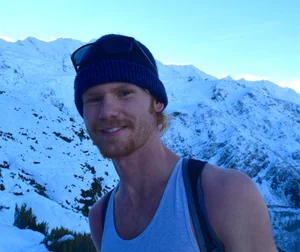
Ryan Gossen is a writer living in Austin, Texas, where he also pursues dance, Brazilian Jiu-Jitsu, and climbing, and is an active member of Texas Search and Rescue. He has had many vocations, including user experience (UX) designer, experimental psychologist, construction worker, arborist, and ski bum. He writes mostly about man’s interaction with nature. More of his writing can be found on his website.