The Airplane Man
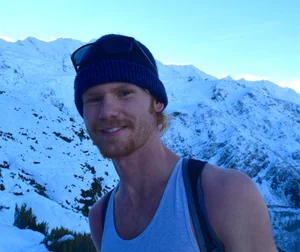
By Teddy Dondanville
I don't run in airports anymore, and I don’t recommend you run either. It’s not worth it. Not even if it means you will miss your flight. Especially if you’re an older gentleman, in your seventies. Doesn’t matter if you lead an active lifestyle. Doesn’t matter if you’re not obese. Those things didn’t matter for the man on American Airlines flight AA3609 from Chicago to Albany, New York. Sure, he made it through the gate and onto the plane in time. But that plane never took off. At least not with him on it.
A woman was screaming, yelling for medical help, her shrieks making the hair on the back of my neck stand up. I’m not a doctor, but I have wilderness medicine training from my work as a rock climbing guide. I was reluctant, but my wife Whitney prodded me to intervene. Maybe my skills would be help.
Before I knew it, I was headed down the aisle of the airplane to confront a man who was lurching, like something was crawling out of his chest. His face was distorted in pain, and he was turning blue. It felt like a horror flick where you see the protagonist naively run toward danger, but can’t stop them. Except this wasn’t the movies, it was real life.
By the time I got to him, another passenger was already standing behind him, desperately searching his neck for a sign of a pulse. Then a third responder appeared at our side. A few moments passed before he stopped breathing. It became obvious the man needed CPR and an automated external defibrillator (AED) if he was going to survive. A flight attendant went for the AED as we hoisted him out of his seat and into the aisle. The poor guy left a puddle of urine in his vacant seat. It looked like spilled engine coolant that won’t absorb into the pavement.
The three of us began delivering chest compressions. In between pounding on the man’s chest, I sent electrical shockwaves through his body with the AED to try and restart his heart.
Each time the machine blared, “SHOCK ADVISED,” I pressed the big green button. I listened, followed instructions, and relied on my training. Each time, he rose up like a demon-possessed person in an exorcism. And each time we returned to giving chest compressions.
After three rounds, the machine fell silent. It wasn’t advising another payload. The rescuer nearest the man’s head checked for a pulse. There was a weak one, thumping meekly in the background like a symphonic bass drum. She lowered her head to his lips as if to hear a secret. Her excited eyes signaled that she heard him breathing.
He was alive, at least for now.
Shortly after resuscitating the man, EMTs carted him off the airplane to an ambulance stationed below the jet bridge. In the aftermath, all the passengers disembarked. The flight crew needed to be switched out.
The three of us gravitated towards one another like magnets. Huddled in a small group in the nearest bar by our gate, we introduced ourselves. Sasha, a nurse practitioner and naval veteran with combat experience, bought the first round. I went straight for bourbon. Rakesh, a medical doctor in his residency, said that he’d never thought he would need to perform CPR for his orthopedic specialty.
The two were curious about my background, too. I explained that as a rock climbing guide, I was a trained and certified wilderness first responder. I’m the sort of person who can clean and bandage the simple wounds you might acquire while recreating outside, or make a splint out of tree branches to immobilize a knee injury so you can evacuate to real medical care. A component of that is CPR and AED training. I was vibrating with adrenaline the entire conversation, afraid my heart might be next. Eventually, after two rounds of drinks and with a fresh flight crew, we boarded the same plane. Seatbelts were pulled over the couple’s empty seats.
But while everyone else flew home, I flew into the beginnings of a multi-year depression.
People precious to me have died. Car accidents, old age, and overdose have stripped them from me. But until the airplane, I’d never been so close to the edge of life and death. And although I was equipped with the training to perform CPR, I was not equipped for dealing with what came after. I fought with the unknown. Did the man continue to survive? If so, what was his life like today? I wondered if what we did was good enough.
After the event, I became haunted by the nightmare of being in that situation myself one day. Scenarios swirled in my mind where I was the one dying and my wife, Whitney, was the one screaming. But no matter how painful that nightmare felt, it paled in comparison to another nightmare, the one where I was watching Whitney die. I reasoned with it as best I could. But the heart attack incident on the plane crystallized the reality that one day, one of us was going to die first, and at first, I couldn’t handle that realization. Over time, things got better. The more I talked about the event, the better I felt about it. My therapist helped me unpack the anxiety I felt about death lurking around every corner. I came to believe that while death is inevitable, the idea of it doesn’t need to be incapacitating.
When I retold the story, family and friends were dumbfounded by my involvement. They helped me realize that in this case, I was a hero. Even though I was just one hero of many, my involvement was heroic enough. And I was proud of that.
Sometime two years later, I was having a good day. I hadn’t had an intrusive thought about my impending demise in quite some time. I was sitting at the kitchen table, slurping a coffee. An email popped up on my phone.
It was forwarded from my mom. She was excited.
“TEDDY! I have been culling through hundreds upon hundreds of emails that have piled up in my email box …. I must have missed this email from December - it was addressed to you referencing the flight, where you helped save that man's life. He wants to thank you!”
My body flooded with relief. It felt like the lead that had been poured into my being, weighing me down, had been melted and transformed into gold.
After that, things started to happen fast. American Airlines customer relations put me in contact with a woman named Connie, the screaming woman from the flight. Then, within twenty-four hours, Connie and her husband, William, the man from the flight, scheduled a phone call with Whitney and me so we could meet.
We spent over two hours on the phone. We learned that William, who goes by Bill, and Connie had been looking for us for two years. But American Airlines' passenger protection regulations thwarted their efforts. In the meantime, they were living on what Bill called “bonus time.” (Bill's bonus time included several European ski vacations, which, as a lifelong skier and ski patroller, he was psyched about.)
We also learned that Bill’s recovery was arduous. He fell back into cardiac arrest, and was saved two more times after we were done with him on the plane. Finally, after this third resuscitation, he was stable enough to receive two separate open-heart surgeries. Connie explained that due to Bill’s impressive recovery, he was selected as the American Heart Association’s (AHA) Distinguished Survivor for their annual Heart Ball fundraising event.
The location of the ball? Our hometown of Albany.
When? In five days.
By the end of the day, we were on the guest list, and I was at the dry cleaners dropping off a suit to be laundered.
A week later, I stepped out of the car at the event. I smoothly traded my keys for a valet ticket like I was accustomed to having my vehicle whisked away. (I wasn’t.) I’d chosen my nicest (and only) suit. My red tie matched Whitney's beautiful red gown. I hadn't looked that good since our wedding. Other elegantly-dressed invitees were streaming into the convention center. They were heart surgeons, survivors, philanthropists, and first responders. Local news trucks were stationed outside. It felt like a big deal.
Somewhere in the building in front of me, Bill and Connie were waiting. I tried to prepare myself for meeting him in person. I didn’t know what I wanted to say when I shook his hand. At home, I had recited responses to interview questions the media were likely to ask. But for Bill, I had nothing.
Once inside, it didn’t take long to locate Bill and his family. Photographers hovered around him like celebrity paparazzi. I walked over and introduced myself. We shook hands. His shake felt healthy and strong. It made me realize that the last time I had touched him, he’d been lying dead beneath me, his white button-down ripped open, his chest laid bare, cables running from the two AED pads.
Now, he looked handsome in his tuxedo, with a red velvet bowtie and cummerbund. He had a well-groomed white mustache and white hair, his blue eyes lively and piercing. He was smiling, and still breathing. Thank God.
“Thank you for saving my life,” he said. Hearing his words felt surreal.
“You’re welcome,” I said. I’m glad you’re here, Bill.”
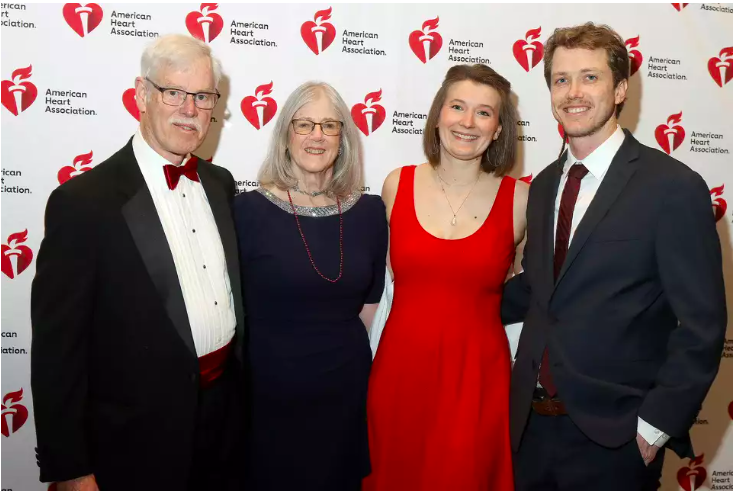
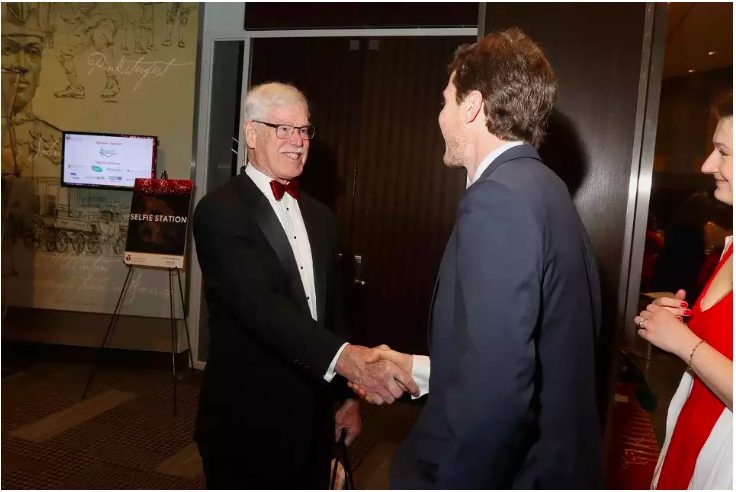
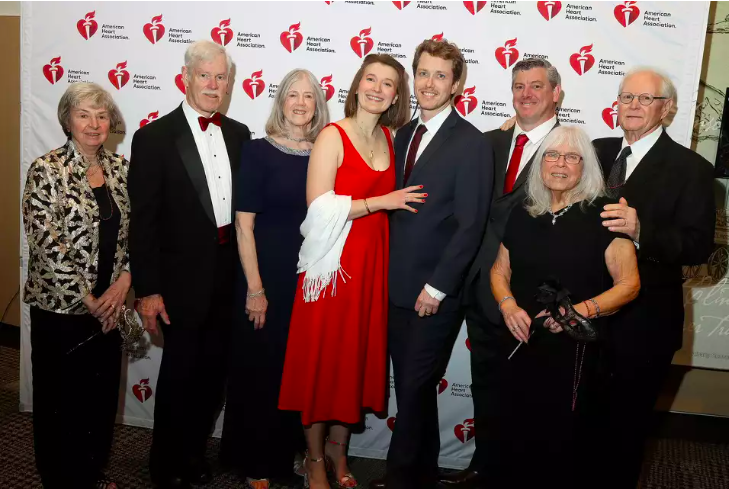
Imagery credit: Joe Putrock / Times-Union
Teddy Dondanville is a freelance writer focused on the outdoor industry and adventure sports. When not enjoying the cerebral and caffeine-fueled pursuits of writing, he works as a rock climbing guide in upstate New York. You can learn more about Teddy on his website.